Salman Khan paparazzi controversy
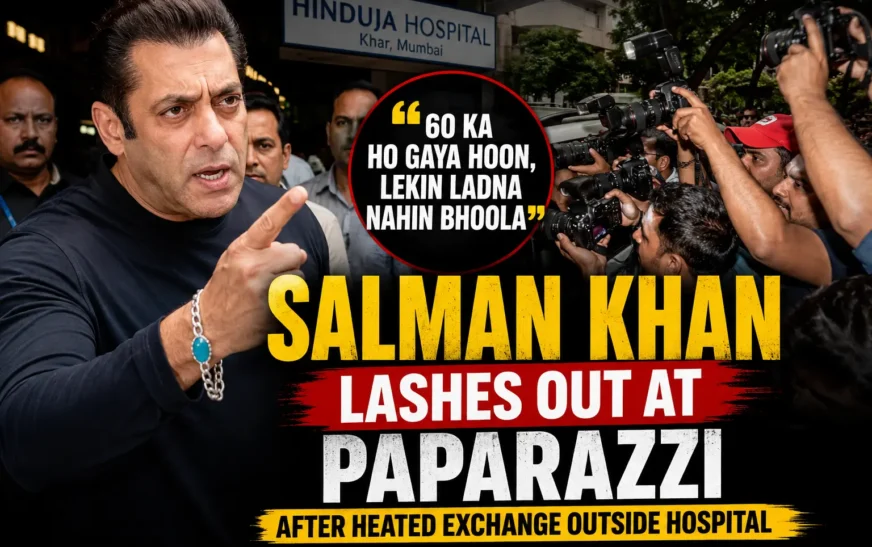
Bollywood superstar Salman Khan had a very public, very emotional confrontation with paparazzi outside Hinduja Hospital in Mumbai — and the internet hasn’t stopped talking about it since. A video of the heated exchange went viral within hours, showing Salman visibly frustrated, raising his voice, and reportedly saying, “60 saal ka ho gaya hoon, thoda toh izzat do.” He followed it up with fiery Instagram posts slamming the intrusive media culture, pushing the now-iconic phrase: “Hospital is not content.” Fans flooded social media in his defence. But not everyone agreed — critics pointed out the complicated double standards of celebrity-media relationships. This Salman Khan paparazzi controversy has become one of Bollywood’s most charged debates of the year: about privacy, human dignity, and where the line gets drawn.
INTRODUCTION
Some moments stop you mid-scroll. Not because they’re shocking. But because they feel uncomfortably real.
This was one of those moments.
A video started circulating on social media — grainy, chaotic, drowning in camera flash — and within hours it had been viewed millions of times. At the centre of it was Salman Khan. Not at a premiere. Not at a promotional event. Not posing for his fans outside Galaxy Apartments.
He was standing outside a hospital.
And the paparazzi were there anyway. Cameras pointed. Flashes firing. Names are being shouted. It was just another Monday in Bollywood.
What followed was a confrontation that nobody saw coming — and that everyone, it seems, had an opinion on. This isn’t just a story about one celebrity losing his temper. It’s about a culture that’s been building for years. And this viral video? It may have just cracked something open.
What Happened Outside the Hospital — About Salman Khan paparazzi controversy
Let’s paint the scene properly, because the details matter.
Salman Khan was visiting Hinduja Hospital in Mumbai — one of the city’s most prestigious private medical facilities. The reason for his visit hasn’t been officially confirmed, but multiple reports suggest it was connected to a personal health-related matter. Not a public appearance. Not a charity visit. A private, personal trip to a hospital.
Now, in any other world, that sentence ends there. A person visits the hospital. The person goes home. Story over.
But this is Bollywood. And in Bollywood, even a hospital visit is a content opportunity — at least, that’s apparently the philosophy.
A large group of paparazzi had set up outside the hospital gates, waiting. When Salman’s convoy pulled up, and he stepped out, the scene turned instantly chaotic. Photographers lunged forward. Camera flashes exploded from every direction. Names were being shouted over each other. Security staff struggled to create any breathing room. The noise was relentless, the crowd aggressive, and the energy of the whole thing felt wrong.
The video that spread shows Salman looking visibly agitated from the first second. His body language is tense. He gestures sharply at the cameras, his voice rising above the din. It’s not the polished, controlled Salman Khan we see at award nights. This is something rawer, more human, more tired.
And that rawness — that single unguarded moment — is exactly what the internet latched onto.
“60 Saal Ka Ho Gaya Hoon” — The Line That Hit Differently
You could write a thousand-word analysis of this entire episode, but honestly, it comes down to one sentence.
“60 saal ka ho gaya hoon… thoda toh izzat do.”
(I’ve turned 60 now… at least give me a little respect.)
That’s it. That’s the line that cracked open a national conversation.
Think about what it carries. Salman Khan — a man who has been one of India’s most followed, most photographed, most obsessively tracked celebrities for over three decades — standing outside a hospital, invoking his age, invoking the word izzat. Not stardom. Not power. Just… respect. Basic human respect.
For fans, that line hit like a gut punch. Here is a man who has given this industry everything. Who has weathered every kind of storm imaginable — professional setbacks, legal battles, industry rivalries, and a relentless media microscope on every aspect of his life. A man whose fans would walk through walls for him. And in that moment, he wasn’t Bhai. He was just a tired 60-year-old man at a hospital, asking to be left alone.
His emotional tone throughout the confrontation was firm, but underneath it — if you watch closely — there’s something that looks a lot like exhaustion. Not anger at any single photographer. Exhaustion of the entire system. At thirty years of this.
That’s what people felt. And that’s why this clip refused to die.
The Instagram Posts That Poured Petrol on the Fire -:
If the video was the match, Salman’s Instagram activity was a full can of petrol thrown onto an open flame.
After the confrontation, Salman did what he rarely does — he spoke directly about it on social media. He posted on Instagram with a force and clarity that made it impossible to ignore. No PR-polished statement. No carefully worded apology for “any offence caused.” Just raw, honest frustration pointed directly at Bollywood’s paparazzi culture.
The central narrative he pushed was both simple and devastating: “A hospital is not content.”
Five words. And they spread like wildfire.
Within hours, that phrase had been screenshot, reposted, quoted in articles, dropped into Instagram captions, turned into Twitter threads, and WhatsApp-forwarded across India. It became the rallying cry of the entire debate. Because it named something that people had been uncomfortable about for years but couldn’t quite articulate.
His posts went further, addressing how celebrities are followed into their most vulnerable spaces — hospitals, funerals, family gatherings — and how those moments of genuine human fragility are then repackaged and sold as entertainment content. He didn’t name specific photographers or outlets. He didn’t need to. Everyone knew exactly what he meant.
What made these posts land so hard wasn’t just the content. It was the timing. Coming directly after the video, they showed that this wasn’t a momentary outburst; Salman had already moved past it. This was a deliberate, considered statement. He was choosing to use his platform to say: enough.
Bhai Army Assemble — How Fans Showed Up in Numbers
Salman Khan ke fans ke baare mein ek baat toh sab jaante hain — they don’t do anything in half-measures.
And this time was no different.
Within hours of the video going viral, the Bhai Army mobilised on every platform simultaneously. Twitter, Instagram, YouTube comments, Facebook groups — all of it flooded with messages defending Salman and condemning the paparazzi. Hashtags supporting him shot to the top of trending lists. Fan edits of the confrontation — with emotional background music, no less — started racking up hundreds of thousands of views.
The comments pouring in were unified in a way that’s actually quite rare for internet discourse:
“A hospital is sacred. Even celebrities deserve peace in such moments.”
“He is a human being before he is a superstar. Remember that.”
“Media ne hadd paar kar li hai.” (The media has crossed its limits.)
“Bhai ne sahi kiya. Itna toh banta hai.”
Even people who aren’t part of Salman’s core fanbase found themselves nodding along. Because the discomfort wasn’t about fandom — it was about something more universal. We’ve all had moments where we needed privacy, needed space, needed to not be watched. The hospital setting made that feeling intensely relatable, even for people who will never know what it’s like to be chased by cameras.
Several Bollywood celebrities also joined the conversation — many choosing the safer route of quietly resharing Salman’s Instagram post rather than commenting directly. But even that quiet gesture signalled something: this wasn’t just one superstar’s isolated complaint. This was an industry starting to collectively push back.
The Other Side: Was Salman Too Aggressive? The Internet Debates About Salman Khan paparazzi controversy
Here’s where it gets complicated. And complicated is always more interesting than simple.
Not everyone was on Team Bhai this time.
A vocal section of social media — smaller in number, bigger in argument — pushed back hard. Their core position: Salman Khan has been one of the biggest beneficiaries of Bollywood’s paparazzi culture for three decades. He’s used media access when it suited him. His films have been promoted partly on the back of the same tabloid machinery he’s now criticising. Airport fashion photos, birthday crowds outside Galaxy, Bigg Boss promotional appearances — none of this happens without the very paparazzi culture he’s now calling toxic.
So the question these critics posed was sharp: can you benefit from a system for thirty years and then only object when you’re on the receiving end of its worst impulses?
It’s not an unfair question.
Others focused on the manner of the confrontation itself. Was the raised voice necessary? Could Salman — who has a full security detail and can quite literally choose to not engage — have handled it more quietly? Some argued that his response, however emotionally understandable, gave the paparazzi exactly what they wanted: a more dramatic, more viral moment than a simple hospital exit would have ever been.
These are the kinds of conversations that don’t have neat endings. They reflect a genuine, deep tension in how celebrity culture works — the transactional, complicated, often hypocritical relationship between fame and the media that manufactures and sustains it.
Why This Story Went So Viral — And Why It Won’t Be Forgotten Quickly
Here’s the part that most entertainment portals aren’t stopping to analyse.
This story didn’t just trend. It stuck. And understanding why tells you something important about where India’s relationship with celebrity journalism is right now.
First: Salman Khan’s unique position. He’s not just a star — he’s a generational symbol. For audiences between 25 and 55, he represents a certain kind of Bollywood masculinity, a certain kind of loyalty, a certain kind of indestructibility. When that person looks tired and asks for respect at a hospital gate, it triggers something deep in the collective fan psyche. The parasocial bond his audience has with him turned what should have been a 24-hour news story into a sustained national conversation.
Second: the setting. Hospitals occupy a special place in our emotional landscape. They’re where we go when things go wrong. They carry associations of fear, love, vulnerability, and mortality that no other public space does. Seeing the paparazzi machine operate in that environment — without hesitation, without apparent discomfort — made a lot of people genuinely uneasy. It crossed an invisible line that people hadn’t formally acknowledged existed, but clearly felt strongly about.
Third: the cultural moment. India’s conversation around digital privacy, media ethics, and the right to be left alone has been growing louder. The Bollywood-paparazzi relationship — once seen as mutually beneficial glamour — is increasingly being viewed through a more critical lens. This incident became the visual shorthand for everything uncomfortable about that relationship.
And fourth — the phrase. “The hospital is not content.” In the age of viral content, quotability is currency. That line was perfectly engineered for sharing, even though it wasn’t engineered at all. It was real. And real always travels further.
Why was Salman Khan angry at the paparazzi?
Salman Khan was upset because a large group of paparazzi aggressively surrounded him outside Hinduja Hospital in Mumbai during what appears to have been a private medical visit. He felt the hospital setting warranted basic privacy and human respect — something he felt was being completely disregarded.
Which hospital did Salman Khan visit? And the Salman Khan paparazzi controversy happened.
Salman Khan was spotted outside Hinduja Hospital in Mumbai. His team has not officially confirmed the specific reason for his visit.
What did Salman Khan say to photographers?
Salman was heard saying “60 saal ka ho gaya hoon, thoda toh izzat do” — meaning “I’ve turned 60, at least give me some respect.” The line became instantly viral and sparked widespread debate about celebrity privacy in India.
Did Salman Khan post about the incident on Instagram?
Yes. Following the confrontation, Salman posted on Instagram directly addressing the toxic paparazzi culture, coining the phrase “Hospital is not content” — which became one of the most widely shared celebrity statements on Indian social media in recent memory.
How did fans react to Salman Khan’s viral video?
Fans rallied strongly behind Salman, flooding Twitter and Instagram with supportive hashtags. Even non-fans acknowledged the discomfort of the situation. The incident sparked a broader discussion about celebrity privacy that went well beyond his core fanbase.
Why is Salman Khan trending today?
Salman Khan is trending because of his emotional confrontation with paparazzi outside a Mumbai hospital — a video that went viral and ignited a major national debate about media ethics, celebrity privacy, and the boundaries of entertainment journalism in India.
CONCLUSION – About the Salman Khan paparazzi controversy
Here’s the truth about this whole episode: it was always going to happen.
Not specifically to Salman Khan. Not necessarily at Hinduja Hospital. But this moment — a major Bollywood star reaching a breaking point with intrusive media coverage in a deeply personal setting — has been building for years. The only surprise is that it took this long.
Salman Khan is not a perfect person, and this is not a story that paints him as one. The questions about double standards and selective outrage are real and deserve honest engagement. But those questions don’t cancel out the central issue this incident raised.
A hospital is not content. Some places are still supposed to be off-limits. Some moments are still supposed to belong to the person living them.
And when one of Bollywood’s biggest superstars — at 60 years old, standing outside a hospital — has to raise his voice to make that point? It says something about how far we’ve let things drift.
The conversation he’s started isn’t going away. And honestly? It shouldn’t.